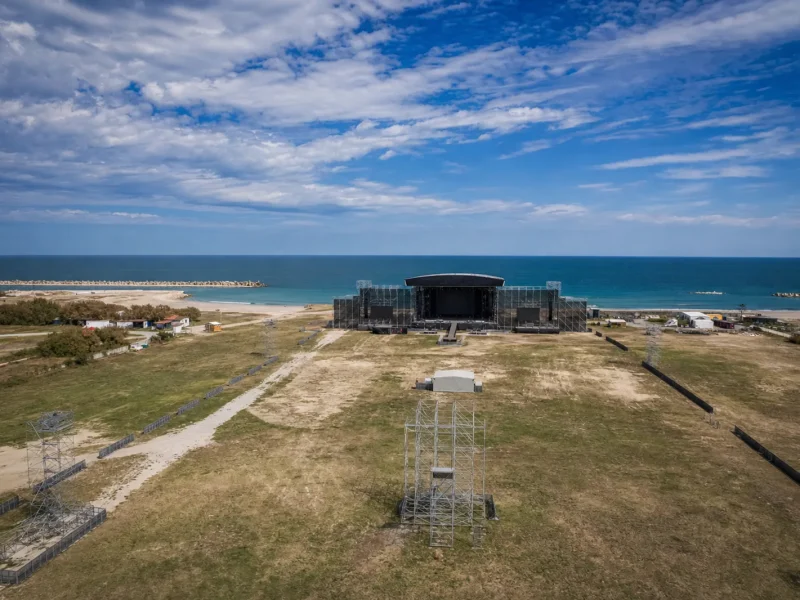
The Beach Please lineup arrives in waves — a teaser announcement, a second drop, sometimes a late addition that turns out to be the thing everyone talks about afterwards. If you’re reading this before the full 2026 bill is confirmed, the stage geography and the festival’s established programming logic will tell you most of what you need to know in order to plan intelligently. If the lineup is already live, this guide explains what each stage means in terms of energy, crowd, and sound.
Beach Please 2026 runs 8–12 July in Costinești on the Romanian Black Sea coast. Five stages, five days, a crowd that takes the music seriously.
—
The Layout: Understanding the Festival Footprint
Beach Please is built into the Costinești seafront, spreading across the Tineretului area and the southern beach zone. The stages are arranged to take advantage of the natural landscape:
- Main stage: faces the sea; large PA, full production, main event headliners
- Second stages: typically indoor or semi-enclosed, often running simultaneously with the main stage
- Beach stages: smaller footprint, closer to the shoreline, programming skews toward deeper and more experimental sounds
- Club stages: indoor venues associated with the afterparty circuit, running from midnight into the morning
Understanding this layout matters because the distance between stages is walkable — in some cases, you can hear one stage from another. Set clashes are real, and managing them well is part of the Beach Please skill set.
—
The Main Stage: Where the Headline Acts Perform
The main stage at Beach Please is a proper festival main stage — full production, elevated screens, the kind of PA that you feel in your chest from 50 metres away. This is where the headline acts perform, typically from early evening onwards, with the biggest draw of each night occupying the 1–3am slot.
What to Expect Musically
The main stage programming spans the broad spectrum of festival-friendly electronic music: melodic house and techno, big-room techno, progressive and peak-time tech-house, and the occasional cross-genre act that defies easy categorisation. The consistent thread is energy — these are acts chosen to peak a large outdoor crowd at midnight on a warm July evening.
Practical Notes
- Crowds build from around 10pm; if you want a central position for a headliner, arrive at the stage by 9:30pm
- The best main stage experience is often mid-crowd rather than front-row: the sound is balanced, the movement is free, and you can actually dance
- On peak nights (Friday and Saturday), the area in front of the stage reaches genuine festival density — be prepared for this, especially in the later hours
—
The Second Stages: Where the Real Discoveries Happen
If the main stage is where you go for the acts you already know you love, the second stages are where Beach Please earns its reputation among people who really follow electronic music.
These stages typically host:
- Techno in its harder, more industrial forms
- Drum and bass and breaks programming on dedicated nights
- Leftfield house and afro-house
- Live electronic acts that require a more attentive, seated or standing crowd
Strategy for Second-Stage Use
The second stages tend to run slightly later than main stage opening — from around 8–9pm — and carry programming through the same overnight hours. Set clashes with the main stage are the central challenge: a headliner you’ve waited years to see versus an artist you’ve never heard live who everyone at the second stage is raving about. Accept that clashes will happen and decide your priorities early.
—
Beach Stages: Daytime to Sunset
The beach stages are the defining aesthetic feature of Beach Please. No other major European festival combines this quality of music with this specific backdrop: open sea behind the speaker stacks, sand underfoot, the horizon uninterrupted.
Daytime Programming (Noon–6pm)
The 2026 edition is expected to expand daytime beach stage programming. Expect:
- Deep house, melodic techno, and nu-disco in the afternoon heat
- Sets from emerging Romanian and regional artists
- Slower tempos that reward listening as much as dancing
This is the best time to find a spot near the stage. Capacity is lower before evening, sightlines are better, and the combination of afternoon sun and quality music is genuinely one of the best things that festival-going has to offer.
Sunset Sets
The sunset slot at a beach stage at Beach Please is a coveted booking — for the audience and the artist alike. As the sun drops toward the western hills behind the town and the sea turns copper, the music typically shifts upward in energy. These sets are consistently among the most talked-about moments of each edition.
Beach stage programming is one of the things guests at Luna Marina ask about most. The hotel is a four-minute walk from the festival entrance, which means slipping out for a sunset set and returning for dinner without missing the headliner is entirely practical.
—
Club Stages: The Afterparty Circuit
The afterparty stages — the indoor venues associated with Costinești’s nightlife infrastructure, including the Tineretului club zone — extend Beach Please’s programming beyond what the outdoor stages can hold.
How Club Stages Differ
- Smaller capacity creates a more intimate relationship between the DJ and the floor
- Sound systems in club environments often deliver different qualities than outdoor stages — more precise bass, less ambient bleed
- Programming tends toward harder, more focused sounds — peak-time techno, minimal techno, fast house
- These stages are where sets sometimes become mythological — the right artist, the right crowd, 4am, nowhere to be until noon
Using Ticket Tiers for Early Access
VIP tickets at Beach Please typically include access to certain stage areas before they open to general admission — useful for securing a position at a high-demand club night without the late-arriving rush. If early access is offered in 2026, it is worth using.
—
Managing Set Clashes: A Strategy
Set clashes are unavoidable at a five-stage festival over five days. The practical approach:
Before the Festival
1. Mark your absolute must-sees — the acts you’d be genuinely disappointed to miss
2. Identify your second-choice for each timeslot where clashes occur
3. Plan your movement between stages; know the walking time between each pair of stages in the footprint
During the Festival
- Arrive early for fixed priorities. Don’t assume you can push through a crowd at 1am.
- Use the early days for exploration. Wednesday and Thursday are lower density; good for finding acts you didn’t know you loved.
- Don’t chase everything. The instinct to optimise every hour leads to exhaustion by day three. Some of the best memories from Beach Please involve staying at a stage for an unexpected act rather than rushing to the next thing.
—
Quick Checklist: Stage Planning
- [ ] Follow the Beach Please official channels for the full 2026 lineup announcement
- [ ] Mark must-see acts in a scheduling app or the official festival app once available
- [ ] Identify your second-choice for each major clash before the festival starts
- [ ] Arrive at the main stage by 9:30pm on peak nights if you want a good central position
- [ ] Visit at least one beach stage set before 6pm — the daytime energy is entirely different
- [ ] Build in at least one afterparty night; the club stages are a distinct experience worth having
—
What Makes Beach Please Different
The honest answer is context. Many festivals book similar acts; very few book them against the Black Sea in early July, in a resort town that genuinely feels like it was built for summer excess, with a crowd that treats the music as the main event rather than a backdrop for social media content.
The stages are the mechanism. The experience is something else entirely.
Join the Luna Marina waitlist for early-bird festival rates and opening updates — Book Now.