Festival accommodation decisions tend to be made by people who have not yet felt what it is like to walk 20 minutes back to a hotel at 4am after five hours on their feet in the heat. They are made in the planning phase — in front of a laptop, comparing prices on booking platforms, optimising for cost or star rating or some feature that seemed important at the time. The walk-time variable is noted, approximated, and then usually underweighted against a price difference that feels significant in the abstract but negligible in context.
This is a near-universal pattern, and it explains why “next time I’ll stay closer” is one of the most common things people say on the Sunday after a major festival. This piece makes the case for why walk-time should be the first variable in any festival accommodation decision — not the last, not a secondary consideration, and not something to compromise away for a marginally cheaper room. The argument is structural, not anecdotal, and it applies specifically to multi-day festivals like Beach Please 2026 in Costinești.
What Walk-Time Actually Determines
Walk-time to the festival gate determines at least five things that are not immediately obvious when you are booking:
- Whether you go back to the hotel between afternoon and evening sessions to change, rest, or collect something you forgot
- Whether you stay for the final act or leave early to avoid the walk home at 3am
- Whether you go out again after a short rest in the afternoon or decide the walk is not worth it
- How quickly you can return if something goes wrong — ill, exhausted, lost a friend, phone died
- Whether you use the hotel for what it is for — recovery, a proper shower, real sleep — or treat it as a distant storage facility that is not quite worth visiting
Each of these effects compounds across five festival days. A hotel that is genuinely five minutes from the gate changes your behaviour — you use it more, you recover better, you make decisions based on what you actually want to do rather than what is logistically practical. A hotel that is twenty minutes from the gate changes your behaviour in the opposite direction — you use it less, you push through when you should rest, and you arrive at day four having not slept or recovered adequately.
The Sleep and Recovery Argument
The academic literature on sleep deprivation is clear on its cumulative effects. Sleep debt is real, it accumulates across days, and its primary symptoms — reduced reaction time, impaired mood regulation, diminished physical performance — are exactly what you do not want across a five-day outdoor festival in July heat. The question is not whether sleep matters at a festival; it is what the accommodation decision does to your sleep quality.
A hotel five minutes from the festival gate makes it possible to manage sleep intelligently. You can go back for a two-hour rest between sets. You can return promptly at the end of an evening rather than adding 20–40 minutes of transit. You can arrive back at 5am and be in bed by 5:10am, giving yourself a genuine six-hour window before the afternoon session. You can use the hotel as the recovery infrastructure it is supposed to be, rather than arriving so exhausted from the walk that the sleep quality you get barely compensates for the energy you spent getting there.
The compounding effect across five days is significant. If a close hotel gives you 30–45 additional minutes of usable sleep per night through faster returns and reduced transit fatigue, that is 2.5–3.5 extra hours of sleep across the festival week. The difference between arriving at day five with genuine energy and arriving at day five barely functional is not primarily about how hard you partied — it is about the accumulated decisions about recovery, and those decisions are shaped significantly by how frictionless the hotel-to-festival loop is.
The Friction Tax
Every unnecessary minute of walking between hotel and festival gate is a friction tax that changes your decision-making. The effect is not dramatic at any single point; it operates at the level of threshold decisions — moments where the friction of the walk is the marginal factor that tips you toward staying when you would benefit from going back, or pushing on when you should rest.
Common threshold decisions at a festival that walk-time directly affects:
- “Should I go back and get a jacket before the evening sets?” (5 minutes: yes. 20 minutes: almost certainly no.)
- “Is there time to go back for a shower before the headline act?” (5 minutes: yes. 20 minutes: probably not.)
- “Do I stay for the closing set or head back now while the path is clear?” (5 minutes: easy to stay. 20 minutes: genuinely harder to justify.)
- “Should I take a two-hour nap this afternoon?” (5 minutes: obviously worth it. 20 minutes: the round trip costs you 40 minutes of your 120-minute rest window.)
None of these decisions is enormous on its own. But across 10–12 such decisions over five festival days, the hotel that is 5 minutes away creates a measurably better experience than one that is 20 minutes away — not because of anything intrinsic to the hotel itself, but purely because the reduced friction changes how you use it.
The Night-Economy Problem
Festival transport infrastructure collapses after midnight. Taxis and ride-hailing services that work reliably during the day become unreliable at 2am during a major festival — drivers are occupied, surge pricing is substantial, and waiting times at peak festival exit moments (end of headline acts, gate close at 6am) can be 30–60 minutes. The people who planned to take a car or bike back to their distant accommodation discover that the plan depends on infrastructure that does not perform under festival demand.
Walking is immune to this problem. If your hotel is 5 minutes on foot, the return journey is always 5 minutes, regardless of what is happening with taxi availability at 3am. This is not a marginal benefit — on one or two nights of every five-day festival, the late-night transport infrastructure will fail some portion of the attendees at the moment they most need it. Being within walking distance of the gate is the one accommodation decision that makes you completely independent of that infrastructure.
The Distance Illusion in Booking
Booking platform maps are particularly bad at representing walking distance in a useful way. “1.2km from the festival site” appears as a small gap on a map. At 1.2km, the walk is 15 minutes — each way. That is 30 minutes of walking for every round trip, and at a large festival you may make 3–5 round trips per day. By the end of day one, a 1.2km hotel has cost you 1.5–2.5 hours of walking that a 350-metre hotel would not have cost.
The calculation that correctly weights this variable: multiply your expected number of return trips per day by twice the one-way walk-time, then multiply by five days. A 15-minute walk, three round trips per day, five days = 450 minutes of walking. A 4-minute walk, three round trips per day, five days = 120 minutes. The difference — 330 minutes, five and a half hours — is a direct input to both your energy expenditure and your sleep potential over the festival week.
What the 5-Minute Threshold Looks Like at Beach Please
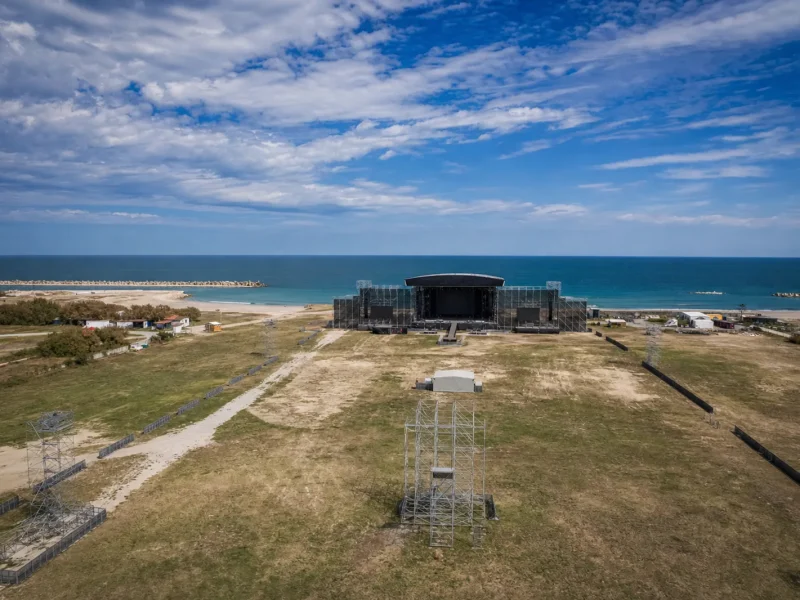
For Beach Please 2026, the practical 5-minute walking radius from the festival gate covers a relatively small section of Costinești. The festival gate sits at the southern end of Plaja Costinești; properties within 5 minutes on foot are concentrated in the Strada Pescărușului zone and the immediately adjacent streets.
Luna Marina, at Strada Pescărușului 35, is 350 metres from the festival gate — a 4-minute walk on the beachfront path. It sits inside the 5-minute threshold that this analysis consistently identifies as the meaningful dividing line for festival accommodation. A 27-room boutique hotel designed specifically around festival-week operation, it provides the sleep infrastructure — soundproofed rooms, blackout curtains, air conditioning, 24-hour reception — that makes the proximity advantage translate into actual recovery rather than just shorter walking times.
Proximity without recovery infrastructure is the hotel that is close but thin-walled, hot, and unmanned at 3am. It gets you back quickly but does not let you sleep. The combination of genuine walking distance and genuine hotel infrastructure is what the 5-minute hotel argument is actually about — and it is rarer than the walking-distance metric alone would suggest.
A Final Note on Price
The hotel that is 5 minutes from the festival gate costs more than the one that is 20 minutes away. This is predictable and correct — the location premium reflects genuine scarcity (there are fewer hotels within 5 minutes than within 20 minutes), and genuine demand (the argument above explains why it is worth paying). The question is not whether proximity costs extra — it does — but whether the premium is justified by its effect on your experience.
Five days of better sleep, five and a half hours of avoided walking, full use of the hotel as recovery infrastructure, and independence from the late-night taxi economy — the case is not difficult to make. The decision to accept a slightly higher rate for a genuinely close hotel is almost always one that festival veterans would make again, and that first-timers can make in advance with the same clarity.
Luna Marina opens August 2026, four minutes on foot from the Beach Please gate. Join the waitlist at lunamarina.com/book-now/ for opening-week pricing.